
In today’s lecture, we’ve talked about the purpose of design and the social responsibilities of the designer.
We started off, by looking at the ‘First Things First’ 1964 manifesto. This piece was published and written by Ken Garland along with 20 other designers, photographers and students, the manifesto was a reaction to the committed society of 1960s Britain and called for a return to a humanist aspect of design. The main argument of this manifesto is that the mainstream media is oversaturated with advertisements that have no higher relevance, nor importance and has no positive impact on our society, that instead of focusing on actual issues and using this media to address it, to the people, we rather advertise cigarettes, alcohol and other consumer goods. In short, it rallied against a consumerist culture and aimed to radicalise designers.
Personally, it was the first time I heard about it and I am glad that such a thing exists because it addresses issues that are relevant today. I myself think that today’s media is oversaturated and with the fast-moving technology it’s not going in any ‘positive’ direction and I feel like we’re not using it ‘correctly’ and if we are… it’s not effective. It’s on such a small scale that it is not noticeable. It’s lost in the ‘noise’ of ‘trivial consumer purposes’.
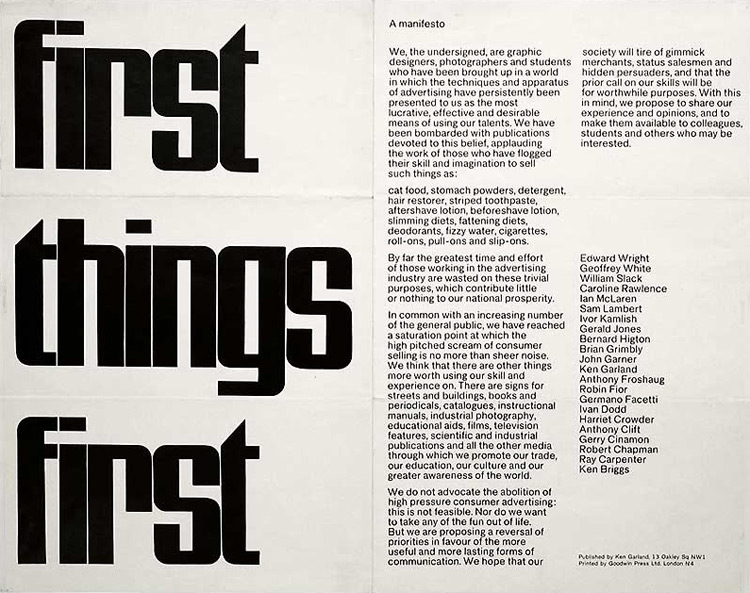 (Garland, 1964)
Moving on, we talked about the early 19th century, when huge factories, manufactured millions of goods and items which had formally been made by people. It started to replace artisans and craftsman for the sake of mass production. Which in my opinion was a natural order of things and with the technology advancement, it was bound to happen. I am an adherent of handcrafted and handmade objects and I totally agree with William Morris, when he said, ‘Have nothing in your house that you do not know to be useful or believe to be beautiful.’ But mass production was unavoidable.
We looked at the Arts and Crafts Movement and its response to mass production, which lead us to the topic of Bauhaus. ‘Design for a better world: Bauhaus’ (1919-1933, Germany)
Bauhaus was a revolutionary school of art, architecture and design established by Walter Gropius at Weimar in Germany in 1919. ‘The Bauhaus teaching method replaced the traditional pupil-teacher relationship with the idea of a community of artists working together. Its aim was to bring art back into contact with everyday life, and architecture, performing arts, design and applied arts were therefore given as much weight as fine art.’
 Bauhaus Building by Walter Gropius (1925–26)
Honestly, I find it difficult to imagine what the world would be like if the Bauhaus had never happened. Many Bauhaus creations are classics and they influence current graphic/product design. I think if the Bauhaus had never existed, a design would be negatively affected, without its philosophy and design approach.
Furthermore, we’ve moved on to the topic of human rights movements and how designers lend their skills to articulate the realities and demands of the movement. We looked at 1963 civil rights in the United States of America and the rise of new protest movement ‘CND’ in the United Kingdom, 1960-63.
I particularly enjoyed talking about postmodern culture in America. Where the advertisements are really saying “Buy me, I’ll change your life” to us, and what we’re being sold is not real-world products but simulacra like “the societal construct of a happy life.” (Ryder, S. 1999.)
 (I shop therefore I am by Barbara Kruger 1990)
The meaning of ‘I shop therefore I am’ is that a person is defined not by what they think but what they own. Kruger is critiquing the materialistic ways of society back then and honestly, nothing really changed, this piece is as relevant as it was when it came out. Now a day’s people, care more about what brand of sneakers they wear rather than focusing on actual characters.
Finally, at the end of the lecture, we were asked a couple of question, which really stuck with me.
How can a designer (Basically future me) affect social and political change?
Can design be more than a service to clients?
When does a designer have to take responsibility for a client’s actions?
At what point must a designer take a stand?
I think that…
Social change is necessary for solving the unsustainable level of consumption in our society. We as designers are learning to do this job as effectively as possible. I guess that’s why we’re here, after all, to get our degree and solve issues in our everyday life. That’s our job. In the past Design, the industry has played a part in the creation of consumerism, therefore, it has a responsibility to play a part in solving the problems it has caused. There is no clear answer on how a designer can effect social change, there are too many factors. I think the best way to go about it, is to really understand the issue your trying to solve, seeing what is needed and finding the best solution to solve issues.
It is our job to improve our society. It does not matter whether you study product design or graphic design, as long as you call yourself a designer your job is to take a stand, focus on the issues surrounding us and fixing them.
_n.









 WOJTAROWICZ