
What I got from this lecture…
Semiology is another term for semiotics. It is a study of signs and symbols and their use or interpretation. During this lecture, I’ve learned that the underlying principles of semiotics were first heard by Saussure’s students. Ferdinand de Saussure was a Swiss professor of linguistics and semiotics. His ideas laid a foundation for many significant developments in both linguistics and semiology in the 20th century.
He says that our language is not a function of the speaker, but it is a product passively assimilated by the individual. It is conventional, it belongs to us all.

But he wasn’t the only one who is considered as the founder of semiotics. Charles Sanders Peirce was an American philosopher, logician, mathematician and scientist who had his own theory for semiotics. The importance of semiotic for Peirce was wide-ranging, as he himself said,
“[…] it has never been in my power to study anything,—mathematics, ethics, metaphysics, gravitation, thermodynamics, optics, chemistry, comparative anatomy, astronomy, psychology, phonetics, economics, the history of science, whilst, men and women, wine, metrology, except as a study of semiotic”
– Charles Sanders Peirce
Pierce and Saussure both had a different interpretation of the field of semiology. Saussure saw it through the lens of language and its structures. So, in his interpretation semiotics is a system of words rather than signs.
Saussure says that the relationship between the concept and the sound image is more likely to be based more on a random choice and personal whim, rather than any reason or system.
On the other hand, Pierce recognized semiotics as whatever that communicates. He saw signs as anything that’s perspective, knowable or imaginable:
“[…]every picture, diagram, natural cry, pointing a finger, wink, a knot in one’s handkerchief, memory, dream, fancy, concept, indication, token, symptom, letter, numeral, word, sentence, chapter, book, library.”
– Charles Sanders Peirce
He had a broader definition of signs.
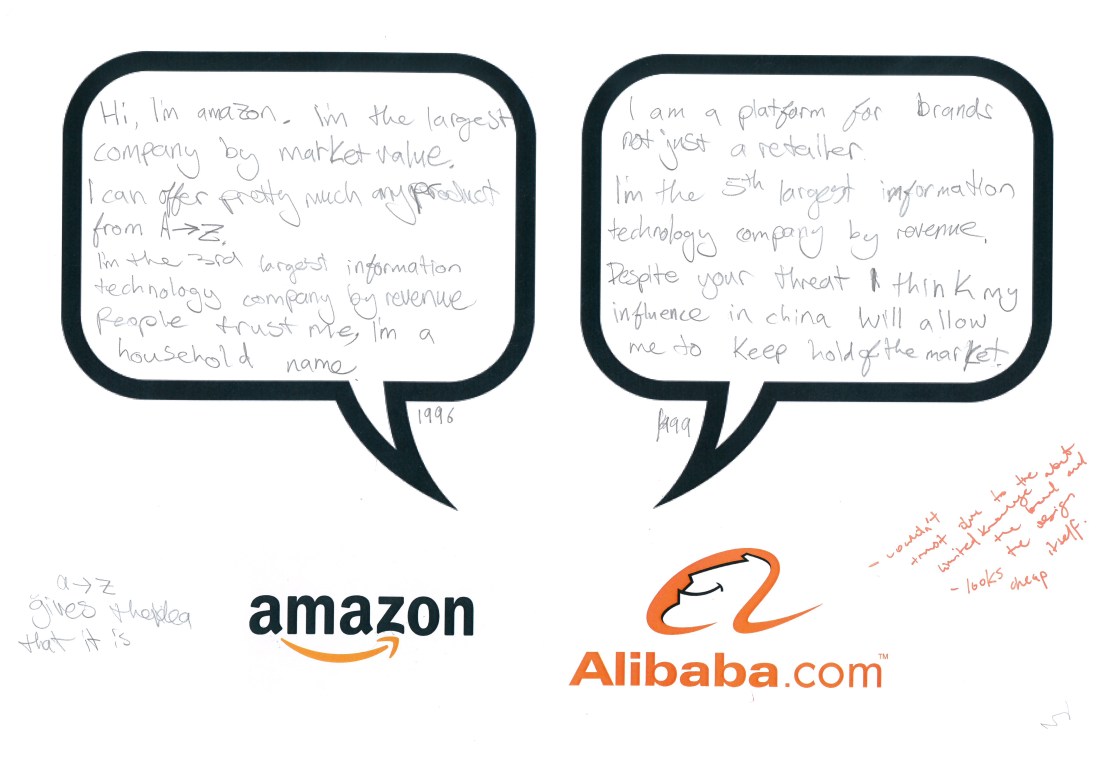
In class activity: We were given two brands, and based on the research in pairs, we created a dialogue between them…
Sign: The information we respond to.
Interpretant: The interpretant is not whoever interprets it, the interpretant is what is made of the sign.
Object: What the sign refers to.
There are three types of signs:
Icon: is a sign that resembles something.
Index: is a sign where there is a direct relationship (smoke means fire).
Symbols: are abstract and deals more with meaning (red means stop).
Today’s emoji are a good example. The impact of a message is predicated on how the information is organised and what signs are used within it. This modern medium may be universally loved but they’re not always universally depicted. Not all of them translate well, which leaves a room for misinterpretation or interpretation. The effectiveness of a product, in this case, ‘emoji’ is measured how many people are using it. It’s about the response and popularity usage.
In conclusion, I really enjoyed this lecture as it opened my eyes to a deeper thought to this subject. Extended research helped me understand that in order for signs to exist and mean anything, they have to be understood. A sign needs an interpretant to stand between it and the object it signifies.
“Semiotics is concerned with everything that can be taken as a sign.”
– Umberto Eco
_n.
 WOJTAROWICZ