
_Chapter 1 review …
Throughout the first chapter, the author discusses the overall change and development of self-portrait and its effects on our ever-changing identities. Thanks to his analysis, I can look at distinct stages of history and pinpoint different aspects from that era and see how they influence today’s status of self-image.
In a sense, Mirzoeff is helping to understand what a self-portrait means. He explores various themes throughout this chapter, which includes the focus on self-image and how gender and heroism are defined through them.
In my opinion, understanding the origins of a concept is important and here Mirzoeff is doing exactly that. He helps us appreciate the beauty and the long journey, ‘selfie’ and self-depiction went through. In a way, as I read through it, it made me more aware of what’s ‘behind’ the selfie.
From what the author is saying I understand that the images that we take of ourselves always have an agenda, no matter whether it is conscious or subconscious. We are always trying to create a better and more interesting depiction of ourselves.
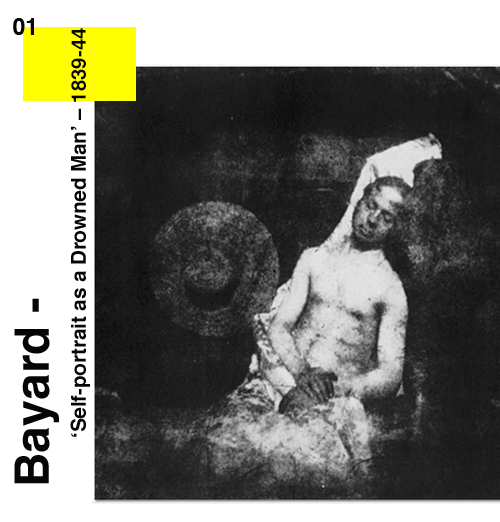
One of the examples that Mirzoeff uses in this chapter is the self-portrait by Bayard, (‘Self-portrait as a Drowned Man’ – 1839-44) also known as the first selfie. This photograph dramatizes the context to create a more interesting image. Here Bayard is trying to convince the audience that they are witnessing a picture of a drowned man, where in reality he wasn’t dead. ‘Some people even though that Bayard really was dead’ (p44) This shows how influential and powerful the depiction of drama and mood presented in this photograph conveys. It is not much different too what we see in today’s modern media. The whole idea is interesting and seductive.

Another great example that surprised me how similar it is to today’s selfies is the self-portrait of Toulouse-Lautrec – ‘ Self -Portrait Before a Mirror’ (1883). He deliberately painted his reflection in a mirror, He chooses what he wants us to see. The painting conceals and reveals the truth. As we can only see his head and shoulders, it tells us that the artist is hiding something. It this case his disability. From what I understood, it challenged the traditional idea of self-portrait and brought new ideas to the genre of self-interpretation.
I think that this is a prime example of a connection between then and now and on how far today’s self-image came to be. Like in today’s world we use filters, edits and cropping tools to remove the unwanted parts in the photos we take, not much different to what he was doing.
In overall in this chapter Nicholas Mirzoeff is making connections between self-image from back then and now. He talks about different experimental uses of this media and how it shaped through the timeline of visual culture. He wants us to know that today’s selfie is here to stay. ‘ It shows how global visual culture is now a standard of everyday life…’(Mirzoeff 69)
 WOJTAROWICZ