
_Chapter 2 review …
In this Chapter, Nicholas Mirzoeff talks about vision. He starts off with describing how different activities affect our ability to see and react. Our understanding of vision changes accordingly to new technologies we develop. We learn that the diagrams of how we see have and how we understand seeing have changed multiple times over the past decade.
Starting with ancient Greeks and Romans who believed that eyes threw rays to ‘touch’ the things we see. They also believed that objects emitted little copies of themselves that got smaller and smaller until they entered the eye, which now for us is an absurd idea, but back then with their technology and their understanding it was completely normal.
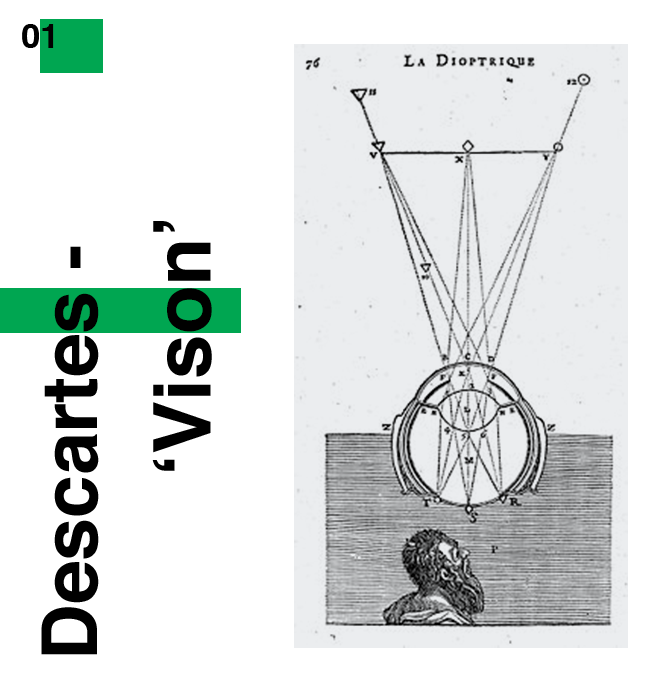
Until Descartes created ‘Vision’ diagram. He compared seeing and understanding of vision to a ‘courtroom’, where the eye presents the evidence for the judge to decide. He was the first one who implemented the idea of light entering our eye. He showed light entering the eye as an asset of geometric lines. By that, he solved the question of how a large object can be seen.
Then came the more modern Fellman’s and Van Essen’s diagram – ‘Hierarchy of Visual Areas’. It reflects well on our times because it shows the idea of vision in a computer as an image. I feel like having an idea of what seeing is, is great, no matter, whether it is an ever-changing diagram.

In summary, he communicates that our understanding of vision and what we see changes deepening on the current technology. Today, Modern neurology is a new way of visualizing the mind – the vital visual metaphor of our time. We will always seek new ways of understanding visual communication and that’s what Mirzoeff is trying to tell us in this chapter.
 WOJTAROWICZ